Solar System Sizing Guide
How to calculate exactly what you need — no overselling, no undersizing. Just the math that matters.
How to calculate exactly what you need — no overselling, no undersizing. Just the math that matters.
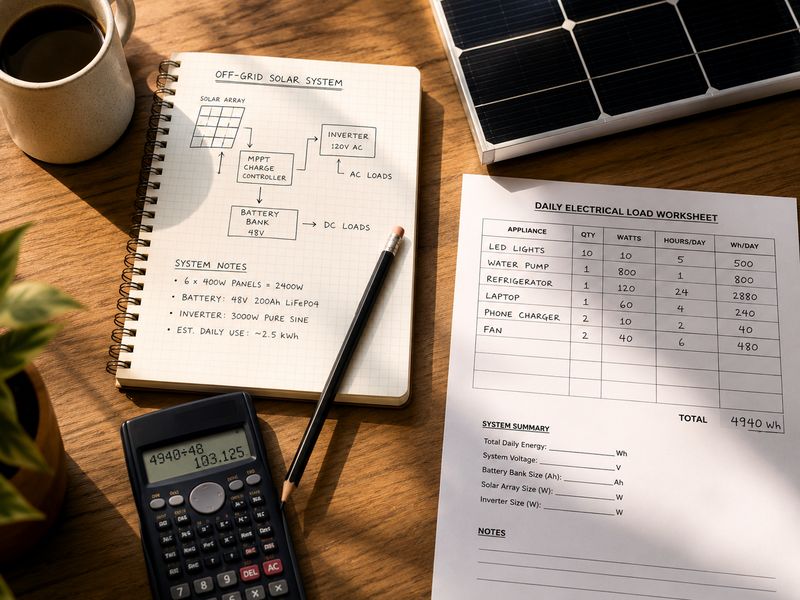
List every appliance you plan to run, its wattage, and how many hours per day it operates. Multiply watts × hours to get watt-hours (Wh). Add them all up.
| Appliance | Watts | Hours/Day | Wh/Day |
|---|---|---|---|
| LED Lights (10) | 100 | 5 | 500 |
| Refrigerator | 120 | 24 | 2,880 |
| Water Pump | 800 | 1 | 800 |
| Laptop | 60 | 4 | 240 |
| Phone Charger (2) | 20 | 2 | 40 |
| Fans (2) | 80 | 6 | 480 |
| Total Daily Load | 4,940 Wh | ||
Divide your daily load by your location's peak sun hours (PSH). Then add 25% for system losses. Most of the continental US gets 4–6 PSH.
For LiFePO4 batteries, you can safely discharge to 20% (80% usable). Plan for 1–3 days of autonomy depending on weather and risk tolerance.
Divide your total panel wattage by your battery voltage to get the minimum controller amperage. Always go one size up.
Your inverter must handle your peak simultaneous load (not daily total). Add up everything that might run at once, then add 20% for surge.
Ready to Build Your System?
Browse our curated equipment picks — real specs, no fluff.
Browse Complete KitsBrowse Panels